Posts

Showing posts with the label realist magic

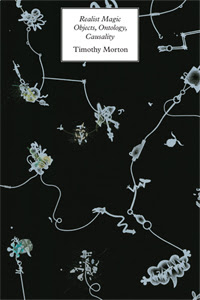
Rick Elmore on Realist Magic

It is here at Environmental Critique . Thanks to Christine Skolnik for showing it to me! Rick is a very intelligent (in my humble view) scholar, and I'm looking forward to reading it carefully.

OOO and Ecology

Realist Magic has returned to Aristotle, but not out of some atavistic desire to wipe away the achievements of modernity and return to an oppressive theocratic regime. It is simply that modernity has now reached a certain limit.This limit is characterized by, to cite only too brief examples, the decisive appearance of nonhumans in human social, psychic and philosophical space.The current ecological emergency consists in this appearance. Some deep paradoxes concerning the Law of Noncontradiction have also emerged, within the very thinking of mathematics that grounds modern science (Cantor, Hilbert, Russell, Gödel,Turing). The contradictory beings that this lineage of mathematics and logic discovered has necessitated an attentiveness to ways in which logic itself might need to violate LNC, the Law of Noncontradiction, especially when it comes to thinking objects.That this appears to be the case despite the founding of modern thinking upon LNC, provides more evidence that...
Object-Oriented Ontology and Impermanence

The Rift between essence and appearance is why an object has an outside. The Rift is why an object exists. The Rift is also how an object can die: its inner, irreducible fragility. Every object has some feature labeled “I am not part of this object.” A hamartia (Greek, “wound”). An inner silver bullet, like a physical version of a Gödel sentence. The inner fragility of an object allows it to be destroyed by another object. Much more importantly, however, inner fragility means that an object can “die” all by itself. Every object is wounded. A hamartia constitutes the object as such in  its determinacy. Impermanence is an intrinsic feature of why an object  is an object. When an object comes into phase with its own fragility, it is destroyed. Consider the Hawking radiation emanating from a black hole. Not everything remains caught within a black hole: even a black hole, the densest object in the physical Universe, is internally inconsistent. At some point, the b...

Object-Oriented Ontology and Memory

The formal cause of something is its past, its memory, as in the memory inscribed in a silicon wafer. Memory precisely is a state in which “everything is there, but nothing is ever present.” We have already encountered the question of memory in thinking the continued existence of objects in the previous chapter. It seems appropriate then that the notion of bardo would come around once more, since bardos are the repetition of memories. This time, however, we are dealing with the bardo of dying, the way in which repetition is caught in something deadly. The (superficial, given) appearance of an object just is its warping by another object, which is another way of saying that the “past life” of an object is its form. What Hegel says about the abstractness of the I cannot be said about how an asteroid piles into Earth, causing a gigantic molten chunk to blurt out the other side and become the Moon.The asteroid never encounters Earth as just a blank screen, onto which it pr...

Object-Oriented Ontology and Ideology

David Wiesner rewrote The Three Little Pigs. In this version, the pigs escape from the book by somehow exiting the page. They find themselves in a curious interstitial space populated with other characters. They bring a dragon back to their world and defeat the wolf. What can we learn from this about our ideological and ecological situation? One is that when we exit from our ideological “world” with its familiar contours, we are still somewhere. Isn’t this the lesson of those interstitial moments in David Lynch movies, in which we see a transition between seemingly coherent worlds? These transitional spaces are not just a void. Maybe philosophy and ideology only thinks these spaces as voids from within a certain kind of philosophical or ideological framework. OOO and Buddhism share something very interesting. They both hold that the interstitial space between things is not a blank void. In fact, it’s charged with meaning, even with causality. -- Realist Magic  

Object-Oriented Ontology and Computational Languages

Gödel argues that because of the inherent inconsistency of all theories, you need another theory to explain the semantics of one theory. Each theory requires 1+n others. Doesn’t this sound awfully like the OOO theory of translation, that objects are apprehended in an interobjective space that consists of 1+n objects?You never hear the wind in itself, you hear the wind in the chimney. I part company with most computational linguists, who hold that computational languages are less expressive than English. I think this is not the problem. I think that computational languages are more explicit and therefore more rigid. English has the advantage of being weak, because it  evolved to be spoken by flesh and blood objects who were trying to keep on keeping on. -- Realist Magic  

Object-Oriented Ontology and the Other

An object is already dreaming about itself, even when it is “sleeping”  (to use Harman’s term), unaffected by another object. This is because of  the profound Rift between essence and appearance. This Rift provides  the impetus for movement and continuity. Just persisting, just remaining  the same, is a strange phenomenon in this regard. The real problem with non-OOO theories of objects—default lumps sprinkled with accidents or cooler flows—is that, as we’ve seen, they are unable to think movement or time without recourse to some non-examined concept that is brought in as  a kind of patch. One way this works is that the interobjective space is taken as the actual reality of objects, when it functions more like the Lacanian concept of the Big Other: just as I am a person called Tim by others  (in  the Big Other in Lacanian terms), so objects are defined by their relations  in interobejctivity. This gives rise to the illusion we call relat...

Realist Magic Online

Image
( Click to view )

Moootion

Someone is wondering how anything can occur in an OOO universe. Really, the question should be the other way around: how come we have allowed models forever that find it incredibly difficult to explain why and how anything happens at all? Realist Magic  is about that . See the cover? See the cover?!