Posts

Showing posts with the label Barbaba A. Beiser Field Station

What's out there? Compiling a biotic index.

Image
Do you know the insect species that inhabit your backyard? What about a local park or nature preserve? How about your county? These are important questions to think about. If no one knows the animal diversity in their area, then why would they stop to think about protecting that diversity?  Some of the most interesting animals are very specialized and need certain habitats to thrive; without those habitats, they'll disappear. I think we can all agree that nature is important, and having a knowledge of your local species (of insects, mammals, birds, plants, fungi...) is empowering. You can see ecological connections and gain a new-found respect for your fellow organisms, just from being able to identify species and know what's around you.  A Luna Moth ( Actias luna ) soon after emerging from the ground. Its wings aren't yet ready to fly--you can see how small they are. With this topic in mind, I've been working for the past few months on gathering together pictures and i...

Species of the Beiser Field Station

Image
I've been busy lately, in a good way. My current project is identifying all the species of insects, spiders, millipedes, and other arthropods I've found at the Barbara A. Beiser Field Station (BBFS) over the past few years as an undergraduate at Marietta College. I spent many hours at the field station and thoroughly explored much of it, taking many photos along the way. I have an article about my experiences coming up in the next issue of the Marietta Natural History Society's newsletter, which I'll link to when it comes out. UPDATE! : You can read my article here (PDF warning). It starts on page 4, titled Beiser Browsings . So far I've identified around 200 arthropods from BBFS. The timeline for my sightings and collections goes back to 2010 or so, when I first started going there for things like labs and work days, and the identifications have been a long time in coming. It feels great to have so many identified though, as there hasn't been a taxonomic inven...

A Calm Millipede's UV Fluorescence

Image
Let's talk about millipedes! You may have read my entry on a millipede that fluoresces under ultraviolet light I found this past fall that grabbed my attention. I've since done some more research, and after working on a poster a few weeks ago for the Ohio Natural History Conference, I have more information and motivation to summarize what I've learned. How did I find out about these UV fluorescing millipedes in the first place? I was on a night hike with some friends last fall and had the foresight to bring a UV flashlight along, just in case there was anything neat to look at under UV. It was a bit chilly, and we weren't finding much. Then I turned the flashlight on. As we passed by areas with fallen leaves, I started catching glimpses of blue-green light: millipedes were fluorescing while milling about in the leaf litter. If you haven't seen this, you owe it to yourself to grab a UV flashlight and check it out. As it turns out, the millipedes I was seeing were o...

An Unfortunate Cicada

Image
I've been reading about cicadas and entomogenous* fungi lately, which reminded me of a picture I had from back in September when I was at the field station working on my capstone project. *This is an awesome new word I learned today-- it means growing on or in the bodies of insects. I found this annual cicada, still in its larval stage, before it emerged as an adult, with fungus growing from it. I was thinking that the fungus itself might have killed it, but that's tough to say for sure. The cicada could have died before the fungus came along, of course. Still, it would be interesting if it was the fungus that killed the cicada. So many fungi associate with the roots of trees, upon which cicadas feed while they're underground. Maybe some species attack the cicadas to protect the tree. Someone should investigate that. ...but not me, currently. I'm focused on capstone for now.

Firefly Mimics - A Crafty Click Beetle

Image
I learned two things during my Investigative Studies Project last summer concerning mimicry:  Fireflies get mimicked a whole lot It's super tricky to separate some of the mimics from actual fireflies, especially when you get into the soldier beetles (family Cantharidae). A group I wasn't aware mimicked fireflies is the click beetle family, Elateridae. During my research I spotted a pretty example of one of the representatives from this family: Unless you were to get on this click beetle's level, you would think it's a firefly. I'm quite pleased with this picture, though it could use a little more touching up later. Denticollis denticornis is this beetle's name, and it was making its way across a moss and lichen-covered log, providing a great background. This is the only species in its genus in North America, and its mimicry of fireflies is a predator defense. I haven't found any information about whether or not the beetle itself is toxic, or if it's jus...

The Luna Moth: A Photo Essay

Image
One of my goals for this past summer was to find as many moths in the family Saturniidae as I could. The saturniids are the moths that give moths great publicity: they're huge, they're colorful, and they make their presence known. In fact, this family includes North America's largest native moth: the Cecropia moth. The Cecropia moth: Hyalophora cecropia . With a wingspan of up to 6 inches , it is a HUGE moth. I was out at the Barbara A. Beiser Field Station often during the summer, and on my first day there, in late May, I struck gold. As I knelt down to examine a Clubtail dragonfly ( Gomphus sp.), I heard a strange rustling in the grass nearby. I took a few quick snapshots of the dragonfly and turned around to see what was causing the ruckus. I could hear it, but due to the dense, wet, matted grass, I couldn't quite find it.  And then I saw it. But...what was it, exactly? My eyes darted around, surveying the yellow, white, and maroon mass crawling towards me. At fir...

Summer Research 2011 - A Biological Survey of the Assassin Bugs (Hemiptera: Reduviidae) at the Barbara A. Beiser Field Station - Other Insects

Image
This past summer, as I mentioned a few times before on this blog, I had the opportunity to carry out a field survey for assassin bugs at the Barbara A. Beiser Field Station. This field station is used by the biology classes at Marietta College for lab sections, such as Zoology and Aquatic Biology. I knew that I would have a good portion of free time during the summer, and I wanted to get a head start on my capstone project, and do some more research with insects. Out of that grew a project during which I would research the abundance, diversity, and ecology of assassin bugs (insects in the family Reduviidae). I wrote up an application for an Investigate Studies Grant for these types of student-led projects from the college, and I received one to carry it out. It took place during six weeks in May and June, and I found a lot of different species--both assassin bugs and other insects. I focused on the assassin bugs most of the time, and presented on my findings (I'll elaborate on tha...

This Isn't Your Father's Daddy Longlegs

Image
While on a night hike looking for fluorescent millipedes and whatever else I could find a few months ago (September 16th), I came across a most interesting arachnid. Now, it's important to note that Arachnids aren't just spiders: Arachnida is a large class that includes other organisms like scorpions, ticks, mites, solifugids, and harvestmen (or daddy longlegs, if you prefer). It's the harvestmen (Order Opiliones) that are most important to this post, and while the popular perception of harvestmen is a small-bodied organism with long, thread-like legs, this is not always the case. There's a surprising amount of diversity in the harvestmen: it includes 6,411 described species (estimates of over 10,000 total species have been put forward!) and 45 families. After spiders and mites, it's the third largest order of Arachnids. Which brings us to the specimen found on that cool September night: Not exactly what you were expecting, eh? This is probably the largest harvestme...

A Charismatic.......and Sometimes Drunk Weevil

Image
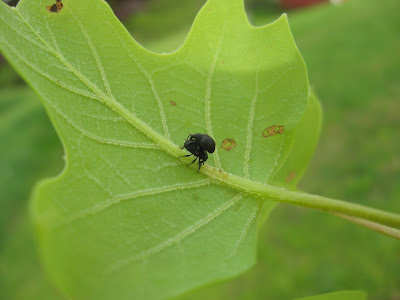
Usually when I find weevils (Coleoptera: Curculionoidea), they're tiny, relatively bland, or....."otherwise occupied." Tulip Tree Weevils ( Odontopus calceatus ) , otherwise occupied. While researching assassin bugs this summer at the Barbara A. Beiser Field Station, however, I came across a much more charismatic weevil, the oak timberworm ( Arrhenodes minutus ). Not quite on an oak, this guy was picked up during sweep netting. If you compare the oak timberworm with the tulip tree weevils in the previous picture, you'll probably notice quite a difference in size and body shape. The oak timberworm doesn't have elbowed antennae, either. So what gives? The oak timberworm is a species of primitive weevil (Subfamily Brentinae), which look very different from other weevils. They're characterized by their straight snouts (their family is the straight-snouted weevils, Brentidae, after all), antennae that aren't elbowed, and the tendency of their body shape to usu...